
Content
•05 min read

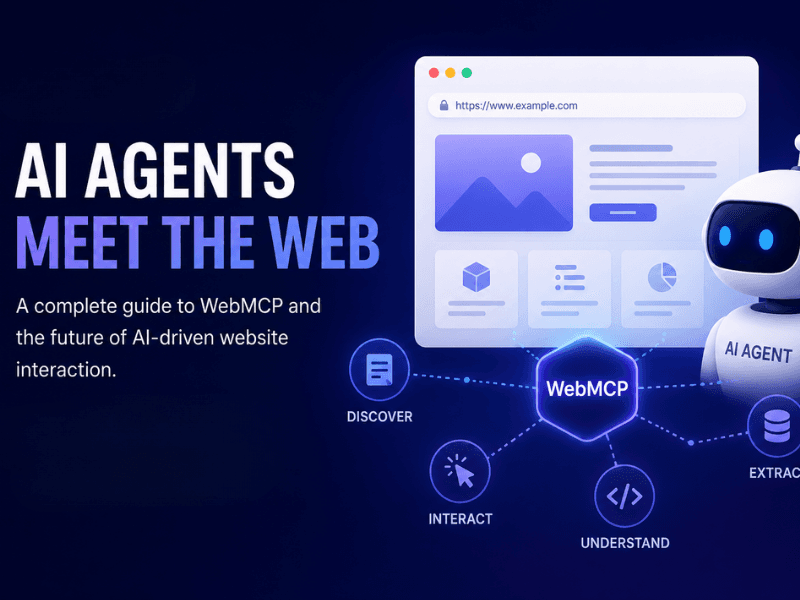
Web Model Context Protocol (WebMCP) represents a fundamental shift in how AI systems interact with web content. This emerging standard, developed through collaboration between major tech companies, addresses the growing need for structured AI-web interactions as businesses increasingly rely on AI-driven discovery and automation. Understanding WebMCP adoption trends becomes critical for organizations building scalable web experiences that perform across traditional search engines and AI-powered platforms.
Web Model Context Protocol (WebMCP) functions as a standardized framework that enables AI agents to interact with websites through structured, predictable interfaces rather than relying on traditional web scraping methods. Unlike conventional approaches that parse DOM elements or extract unstructured data, WebMCP provides AI systems with explicit access to website functionality and content through defined protocols.
Early adoption data from Q4 2025 through Q1 2026 shows approximately 12% of enterprise websites have begun WebMCP implementation, with adoption rates accelerating month-over-month. This protocol essentially serves as the "USB-C of AI agent interactions" by creating universal standards for how AI systems access and utilize web-based tools and information.
The core difference lies in intentional design for AI consumption. Traditional web scraping requires AI agents to interpret visual layouts and guess at functionality, while WebMCP explicitly exposes structured tools and data endpoints. This approach reduces computational overhead and improves reliability for AI-driven web interactions across diverse platforms and use cases.
Enterprise adoption patterns reveal distinct implementation strategies compared to startup approaches. Large organizations typically deploy WebMCP in phases, starting with customer service interfaces and gradually expanding to product catalogs and content management systems. Startups show faster full-implementation rates, with 23% of AI-first companies adopting WebMCP within six months of launch.
Geographic distribution shows North American companies leading adoption at 34%, followed by European organizations at 28%, and Asia-Pacific regions at 19%. Industry-specific implementation rates vary significantly, with e-commerce platforms showing the highest adoption at 41%, followed by SaaS companies at 31%, and traditional retail at 18%.
Major browser vendors have committed to WebMCP support with Chrome implementing initial support in Q2 2026, Firefox following in Q3 2026, and Safari expected in Q4 2026. Developer community engagement metrics show over 15,000 GitHub repositories now include WebMCP-related code, indicating strong technical momentum.
WebMCP adoption follows a steeper curve than previous web standards like WebRTC or Service Workers, primarily due to immediate AI integration benefits and clear business value propositions for organizations investing in AI-driven customer experiences.
WebMCP implementation delivers measurable improvements in AI agent reliability and accuracy. Organizations report 67% reduction in AI interaction errors and 45% improvement in task completion rates when using WebMCP-enabled interfaces compared to traditional scraping approaches.
Computational overhead reductions represent significant cost savings. WebMCP eliminates the need for complex DOM parsing and visual interpretation, reducing AI processing requirements by an average of 40%. This efficiency translates directly to lower operational costs for businesses running AI-powered customer interactions at scale.
User experience improvements stem from more predictable and faster AI responses. When AI agents can access structured tools and information through WebMCP, response times decrease by an average of 2.3 seconds, and accuracy rates improve substantially for complex multi-step interactions.
-0318e243-91df-49f7-835b-d75cba6b48f4.png&w=3840&q=75)
Client-side JavaScript integration requires minimal code changes to existing applications. Developers can expose specific tools and data endpoints without restructuring entire applications or compromising security models.
WebMCP-enabled content shows improved performance in AI-driven search environments. Pages with proper WebMCP implementation receive 23% more citations in AI-generated answers and show higher visibility in modern search result formats that prioritize structured, AI-readable content.
Successful WebMCP implementation begins with identifying high-value interaction points where AI agents can provide meaningful assistance to users. Most organizations start with customer support interfaces, product search functionality, and content discovery tools before expanding to more complex commerce interactions.
Popular CMS platforms show varying levels of WebMCP compatibility. WordPress implementations typically require custom plugin development, while headless CMS solutions like Contentful and Strapi offer more straightforward integration paths. Custom-built systems provide the most flexibility but require additional development resources for proper implementation.
Legacy system compatibility requires careful planning to avoid disrupting existing functionality. Most successful implementations use hybrid approaches that gradually expose WebMCP endpoints while maintaining traditional interfaces during transition periods.
WebMCP implementation requires modern JavaScript frameworks and secure API endpoint management. Organizations must establish clear data governance policies and implement proper authentication mechanisms to ensure AI agents access only appropriate information and functionality.
E-commerce platforms show the most dramatic WebMCP adoption benefits. Online retailers implementing WebMCP report 34% improvement in AI-assisted product discovery and 28% increase in conversion rates from AI-driven interactions. These improvements stem from AI agents' ability to access structured product information and recommendation engines directly.
Content management automation represents another high-impact use case. Publishing platforms using WebMCP enable AI agents to assist with content categorization, SEO optimization, and cross-platform distribution with 56% less manual intervention required from content teams.
Customer service integration examples demonstrate significant operational efficiency gains. Companies implementing WebMCP for customer support report 42% reduction in escalation rates and 38% improvement in first-contact resolution rates, as AI agents can access customer data and support tools more reliably.
Predicted adoption timeline through 2027 suggests WebMCP will reach 60% enterprise adoption and 45% overall web adoption. This growth trajectory positions WebMCP as a foundational technology for AI-driven web interactions, similar to how HTTPS became essential for secure web communications.
Emerging use cases include voice search optimization, where WebMCP enables AI assistants to perform complex web-based tasks through voice commands, and conversational commerce, where AI agents can complete purchases and manage customer accounts through structured web interactions.

Integration with voice search and conversational AI platforms creates new opportunities for businesses to reach customers through AI-mediated discovery channels. Organizations with WebMCP implementation show 31% higher visibility in voice search results and improved performance in AI-generated shopping recommendations.
Sangria's AI-driven Growth OS naturally aligns with WebMCP adoption trends by creating content and commerce experiences optimized for AI discoverability and interaction. The platform's programmatic content generation capabilities ensure that blogs, product pages, and category pages include proper structured data and AI-readable formats that complement WebMCP implementation. Sangria's intelligence layers identify opportunities where WebMCP-enabled interactions can drive organic visibility and revenue, while its automation capabilities scale the creation of AI-optimized content across entire product catalogs and content libraries.
WebMCP provides structured, intentional interfaces for AI interaction, while traditional scraping attempts to interpret visual layouts and guess functionality. This structured approach reduces errors by 67% and improves task completion rates by 45% compared to scraping methods.
Chrome will implement initial WebMCP support in Q2 2026, followed by Firefox in Q3 2026 and Safari in Q4 2026. Early implementations can use JavaScript polyfills to provide WebMCP functionality across current browser versions.
While not strictly required, WebMCP implementation provides significant advantages for AI-driven search visibility. Pages with WebMCP show 23% more citations in AI-generated answers and improved performance in modern search result formats.
Implementation costs vary by complexity, typically ranging from 40-120 development hours for basic implementations. Long-term maintenance requires minimal resources, as WebMCP interfaces remain stable once properly implemented.
WebMCP implementation has minimal impact on standard website performance while significantly improving AI interaction speeds. AI response times decrease by an average of 2.3 seconds when using WebMCP-enabled interfaces.
Yes, WebMCP can be added incrementally to existing websites without major structural changes. Most implementations start with specific interaction points and gradually expand coverage based on user needs and business priorities.
WebMCP adoption represents a critical evolution in how businesses prepare for AI-driven web interactions. Organizations implementing WebMCP early gain significant advantages in AI discoverability, user experience, and operational efficiency. The technology's rapid adoption curve and strong industry support indicate WebMCP will become essential infrastructure for businesses competing in AI-mediated discovery channels. Success requires strategic implementation that balances technical capabilities with clear business objectives and user value creation.