Category
•06 min read


Search impressions rose 49% year-over-year in 2025 while click-through rates fell 30% — and most enterprise dashboards registered neither anomaly, because they were not built to detect one. The standard rank-tracking instrument panel measures where a URL sits in organic results; it does not measure whether a brand appears in the AI-generated summary that resolves the query before a user ever reaches those results. Rank position has become a structurally misleading performance signal, and the brands still relying on it are operating with an incomplete instrument panel.
Google AI Overviews have decoupled impressions from clicks: +49% impressions, -30% CTR (BrightEdge, 2025), with Ahrefs reporting 58% lower CTR for top-ranking pages where an AI Overview is present.
Position-1 ranking no longer guarantees inclusion in the answer most searchers receive — citation frequency inside AI-generated summaries is the operative unit of discovery value.
Effective measurement in this environment requires four signals standard rank-trackers do not capture: citation frequency, sentiment accuracy, source attribution, and answer-engine share-of-voice.
No standardised, independently verified framework for AI Overview brand attribution exists — this is simultaneously a data gap and a competitive opening.
Brands that instrument AI citation visibility before the measurement category consolidates accumulate a structural advantage in content positioning that compounds over time.
BrightEdge reported a 49% year-over-year rise in Google search impressions alongside a 30% decline in CTR, attributing both movements directly to AI Overviews absorbing query resolution on-page (BrightEdge, 2025; vendor-reported, large dataset, single-vendor origin). Ahrefs, measuring independently, found that the presence of an AI Overview correlated with a 58% lower CTR for the top-ranking organic page — up from an earlier estimate of 34.5% (Ahrefs, 2025; vendor-reported, methodology not publicly peer-reviewed).
Two vendors, separate methodologies, the same directional finding: AI Overviews are intercepting query resolution before users reach organic results. The mechanism is straightforward — when the answer appears in the summary, the incentive to click through disappears.
A dashboard that tracks only traffic volume and rank position will show rising impressions and interpret them as health. The click collapse happening simultaneously will read as a minor CTR fluctuation. Neither signal, in isolation, surfaces the structural problem — which raises the question of what signal actually does.
AI Overviews do not follow rank-order citation logic. A page ranked third or fifth may be cited in the AI-generated summary while the position-one page is not referenced at all. Google confirmed deployment of AI Overviews across more than 100 countries by early 2025, making this citation behaviour a standard operating condition rather than an experimental edge case (Google, 2025).
A brand can hold position one for a high-intent keyword and still be absent from the answer the majority of searchers receive. This is not a content quality failure or an algorithm penalty — it is a measurement category failure. The brand is invisible not because it ranked poorly, but because citation frequency and rank position are distinct metrics that do not reliably correlate.
The operative question shifts from where does this URL rank to how often is this brand named inside AI-generated answers for its target queries — and that question requires an entirely different instrument.
Platforms including Semrush, Ahrefs, and Surfer SEO have introduced AI visibility dashboards that track brand mentions across Google AI Overviews, ChatGPT, Gemini, and Perplexity (vendor-reported; features are nascent, cross-platform normalisation is not standardised). Their emergence confirms practitioner recognition that citation frequency is a distinct measurement category — but no independent audit of their accuracy exists in the public domain.
Citation frequency measures how often a brand is named inside AI-generated answers for a defined keyword cluster — the AI equivalent of share-of-voice. Sentiment and accuracy auditing addresses a separate problem: AI systems synthesise from multiple sources, and the description a brand receives may be accurate, outdated, or drawn from a competitor's framing. Source attribution tracking identifies which pages are being cited — and which competitor pages are being cited instead — providing the structural intelligence that informs content prioritisation. Answer-engine share-of-voice measures, across a target keyword cluster, what percentage of AI-generated answers include a brand versus a competitor.

No standardised, independently verified framework for these four signals exists in the public domain. That is a data gap, not a finding — and it is precisely what makes the next question consequential.
When a measurement category has no industry-standard framework, the brands that build instrumentation first accumulate structural advantage before the gap closes. Citation footprint, content positioning intelligence, and competitive source attribution data all compound — a brand cited consistently across AI-generated answers for its target queries builds a reinforcing signal that influences future citation behaviour.
This is a reasoned inference from the structural data, not an empirically established finding. No primary study on AI Overview first-mover citation advantage exists at time of writing. But the logic follows directly from Pillars 1 through 3: if citation frequency is the operative metric, if it does not correlate with rank position, and if no standardised measurement framework yet exists, then the brands that instrument this layer now are operating with intelligence their competitors do not have.
Sangria's intelligence architecture treats this measurement layer as foundational infrastructure — mapping which queries trigger AI Overviews within a brand's target keyword cluster, identifying which competitor pages are being cited, and using that intelligence to prioritise content generation before the citation gap widens.
The data from 2025 is directionally unambiguous: AI Overviews have structurally decoupled impressions from clicks, and rank position no longer guarantees inclusion in the answer most searchers receive. The measurement infrastructure required to operate in this environment — citation frequency, sentiment accuracy, source attribution, answer-engine share-of-voice — is not a supplement to existing dashboards. It is the replacement instrument panel.
No standardised framework for AI Overview brand attribution exists yet. That absence is both an operational challenge and a time-bounded competitive opening. Brands that build citation measurement infrastructure before the category consolidates will hold a structural advantage in content positioning and competitive intelligence that compounds as measurement norms eventually settle.
The brands that treat AI-generated discovery as infrastructure — not as a campaign variable to optimise reactively — are the ones that will still be cited when the category standardises and the gap closes.
Sangria's intelligence layer continuously maps the query landscape to identify where AI Overviews are active, which sources are being cited, and where a brand's content is structurally absent from the answer. Its execution layer programmatically generates AEO-optimised content — blogs, PDPs, collection pages — architecturally positioned to be cited by AI systems. The outcome is a compounding citation footprint that converts AI-mediated discovery into measurable commercial outcomes, treating citation coverage as foundational infrastructure rather than a reporting afterthought.
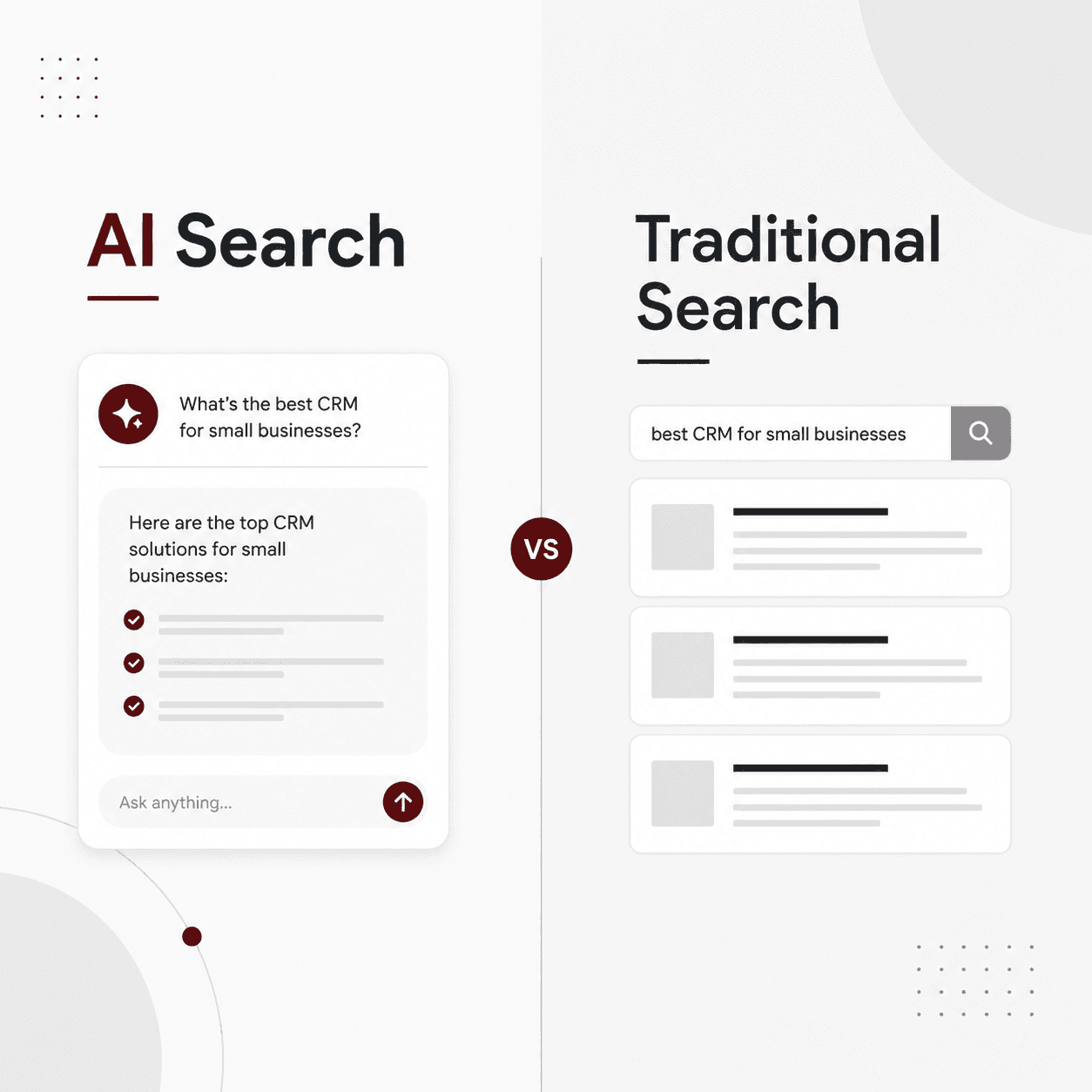
A featured snippet pulls a direct excerpt from a single ranked page and displays it above organic results. An AI Overview synthesises information from multiple sources using generative AI, producing a composite answer that may cite several pages — or none explicitly. The distinction matters for measurement: featured snippet tracking tools do not capture AI Overview citation behaviour.
No. AI Overviews synthesise from multiple sources and do not follow a strict rank-order citation logic. A page ranked third or fifth may be cited while the position-one page is not. This is why citation frequency is a distinct and more consequential metric than rank position in an AI-mediated discovery environment.
Semrush, Ahrefs, and Surfer SEO have introduced AI visibility dashboards covering citation tracking across Google AI Overviews, ChatGPT, Gemini, and Perplexity. Their coverage and accuracy vary, and no independent audit of tool reliability exists in the public domain — treat platform-reported citation data as directional rather than definitive.
Sangria treats AI citation coverage as a structural intelligence problem, not a reporting task. Its architecture maps which queries trigger AI Overviews within a brand's target keyword cluster, identifies which competitor pages are being cited, and uses that intelligence to prioritise content generation — ensuring that the pages most likely to be cited are built and optimised before the citation gap widens.
Based on observational data from SEO platforms, structured and authoritative content — well-organised blog posts, FAQ pages, and product description pages with clear entity signals — appears more frequently in AI Overview citations. No peer-reviewed study has confirmed a definitive content-type hierarchy; treat platform-reported patterns as directional guidance, not prescriptive rules.
The shift from SERP ranking to AI-generated summary is not a future scenario — the 2025 data confirms it is the current operating environment. Impressions are rising, clicks are falling, and the brands still measuring only rank position and organic traffic are working from an instrument panel that cannot detect the structural change already underway.
Sangria's architecture is designed for exactly this operating condition: treating AI-generated discovery not as a feature to optimise for, but as the primary infrastructure through which commercial outcomes are built. The measurement gap is the competitive gap — and it is closing on a timeline set by the brands moving first.
BrightEdge. (2025). AI Overviews and organic search performance: Impression and CTR divergence report. BrightEdge Research. Vendor-reported; single-vendor origin; no independent replication confirmed at time of writing.
Ahrefs. (2025). Impact of AI Overviews on organic click-through rates. Ahrefs Blog. Vendor-reported; methodology not publicly peer-reviewed; directionally consistent with BrightEdge findings.
Google. (2025). AI Overviews global rollout: Expansion to 100+ countries. Google Search Central Blog. Platform primary source; high confidence.
Semrush. (2025). AI visibility dashboard: Brand citation tracking across AI answer engines. Semrush Product Documentation. Vendor-reported; feature existence publicly documented; independent accuracy audit not available.
Ahrefs. (2025). AI visibility tracking features. Ahrefs Product Documentation. Vendor-reported; cross-platform normalisation not standardised.
Surfer SEO. (2025). AI Overview citation monitoring. Surfer SEO Product Documentation. Vendor-reported; methodology varies from competing platforms.